Sunday, September 21, 2008

Freaks and Geeks, the real-life edition

So I've been looking at high school photographs recently, and realized how well my (old) social groups fit into the categories described by Judd Apatow's ingenious (albeit short-lived) dramedy Freaks and Geeks. Decide for yourself, and keep in mind the differences between Apatow's affluent Michigan suburb and an inner-city Chicago Public School.

The freaks:
The geeks:And a third social group, which for some reason I can't quite pigeonhole into a stereotype:When I think about it, I was pretty much a complete nerd, so it would be more fitting to label the first as Geeks, the second as Dorks, and the third as... well, probably Freaks.

If I rationalize hard enough I can sort of see a Lindsay Weir parallel in the last one. If I really really try. I'm smirking, right? Right? Right.

(And check out the messenger bag and combat(ish) boots in the last picture. Man, I thought I was so cool. And this wasn't even during my short-lived emo-goth phase sophomore year.)

Let's see... I'd be Lindsay (YAY!), to the left is the dude played by Seth Rogen, to the right are James Franco and Jason Segel. Oh man, I wish my life were a dramedy.

Cue pretentious literary quote:

"Life is a comedy for those who think, a tragedy for those who feel"--Horace Walpole

To those reading that somehow take offense at their being called either a freak or a geek (although I doubt anyone reading would take offense), stereotypes are stereotypes for a reason. Just because there's a hipster, indie, scenester, hippie, punk, or emo culture doesn't mean everyone fits into any of them, and that anyone involved with any of the movements is somehow labeled as the typical member of said movement. Except punk. Punks are totally punk. Punks are totally punk because they love telling other people about how amazingly punk they are. So they're the exception. If they're actually punk. (End rant)

Why do I love labels so much? Probably because of how simultaneously right and wrong they are. They're walking contradictions!

Wednesday, September 17, 2008

Parlez-moi de la pluie

Let it be known that I came upon this movie by accident, and so far have not read any of its reviews. Thus, I'm very uneasy reviewing it, and even more uneasy formulating an opinion, so bear with me.
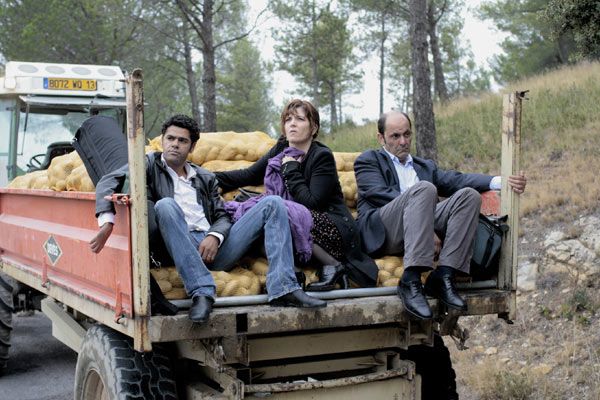
"Parlez-moi de la pluie" (English version: "Let it Rain") had the potential to begin, develop, and end like your average french romantic comedy, vis-a-vis "My Best Friend," or anything you had to sit through in French 101. Happily for us, many parts of this largely solid and well-made film were quite surprising. "Parlez-moi de la pluie" has the all-too-common element of being a movie-about-filmmaking: Karin, a hotel receptionist (Jamel Debouzze of "Amelie" fame), seeks to make a documentary involving Agathe Villanova, an infamous Feminist and academic. Karin, however, is no feminist, and what in the heck he's making the film for remains ambiguous (that, or simply lost in translation). Karin employs the help of filmmaker Michel Ronsard (one of the film's writers: Jean-Pierre Bacri), under whose guise a great web of events unfold. "Parlez-moi de la pluie"-- translation: Talk to me about the rain (the beginning of the statement "Parlez-moi de la pluie et de beau temps," which roughly translates to "Talk to me about the weather")-- thus has serious feminist undertones. This, for someone who previously thought of the French as largely sexist, was uplifting. Beware, feminism in France only goes so far, and by the end of the film, we are back at square one. Agathe is hardworking, ambitious, and remarkably intelligent-- a stark contrast to the passive and docile other French women. But that is also her downfall, as stress is placed on her seemingly perfect relationship. What does this say about womankind in France? Must she be passive to maintain happiness? The film implies nothing, and we find ourselves with a vast quantity of interesting themes without a creative outlet to explore them. Nonetheless, "Parlez-moi de la pluie" is slightly more intellectual than your average French comedy, and definitely worth a quiet afternoon at the cinema. Music-wise, it is interesting: an operatic background during seemingly random moments, thus making it slightly awkward artistically. And, like all French movies, and all art in general, it is about love. Love and mistakes, love and jealousy, love and an imbalance of affection-- it is all of the above, with a few chuckles in-between.

Sunday, September 14, 2008

Pommery

Visited "Pomery Cave" a champagnery (champagnerie?) as well as some sort of contemporary art museum. Really a magnificent, glorious place. I love the mixing of old and new. All of this is many meters under the earth, in a cave kept at 55 degrees F. Here are my favorites of the (very random, very cool) art pieces:

One room had guitars with finches flying all over the place. The guitars were plugged in (I checked), and there was sawdust on the floor. Very cool. Just my style.

These are just some of the champagne bottles in the Pommery Cave. I liked the way the photo turned out.
Isn't this just so Magritte-inspired? Try to figure out how the shadows look the way they do.Closeup.

A print. Silly guide got in the way.

Friday, September 5, 2008

Graffiti

Random sightings of cool graffiti in Paris while out and about in the Quartier Latin:


Sunday, August 31, 2008

Valse Avec Bachir


Unlike many, I have a great fondness for epic and self-indulgent films. So much so, in fact, that I almost prefer them to solid, plot-driven films like "The Visitor". As stated many a previous entry, when it comes to the question of style versus substance, it's style all the way. "Valse Avec Bachir" was breathtaking in this respect, difficult in others. I'm not sure whether it was a culture barrier (I saw this in a French movie theatre with French subtitles, so my knowledge of the plot might be a tad stilted), but by the ending credits of this well-paced 90-minute film, they were breathless. They sat through the entire ending credits, leaving me-- antsy, lost in Paris, extremely hungry--forced to stay the extra 5 minutes with them. I thought I heard a neighboring woman force back a sob at the end.

The themes are some of my favorite film archetypes: the (blurry) division between fantasy and reality, the absurdity and profoundness of human suffering, the anguish and trauma of war, the immense guilt following the realization of one's use as a political and military tool of war, the loss of human identity... but I'll stop before this becomes any more pretentious than it already is. I have an embarassing ability of "giving it all away" in movie reviews, so I'll keep this (relatively) brief. An Israeli man, twenty years after his obligatory service in the army and the war with Lebanon (in which he was a soldier), has forgotten all of his gruesome military past... that is, until, via a friend's account of a bizarre dream, his memory jolts, and all flows back to him. But is it real? Is he "making up" false memories? And how large of a part did he really play in the brutalities of this war?

I found it astounding that such a self-reflective, self-critical film can come out of warmongering, terrifyingly proud Israel (forgive me for the criticism, though I do love the country, very much). Details about the Israelis do not go unnoticed: reflections about the holocaust, the very Jewish look about their mothers and families (aquiline noses, thick dark hair of the Ashkenazi, light eyes, often a sad and surly expression). Then there are other details: a single soldier donning a yarmulke, a painfully slow application of the teffilin, a flashback of a mother frying latkes in a pan... I couldn't help wondering if the French, known for their antisemitism, would get these references. The main theme, the basic thesis underlying the story, was probably obvious to all: we have become them-- the murderers of our families, the brutal culture we have never been.

This depth makes it extraordinarily difficult to watch; I couldn't imagine anyone in my immediate family not bursting into tears, however much they claim to dislike animated movies. I, however, am more than a bit obsessed with cartoons and animation, and did not as much as tear up during the course of the film. Stylistically, it's astounding, shot in what I assume is the rhetroscopic film editing of Linklater fame in "A Scanner Darkly", and, less so, in "Waking Life". Most likely the film was shot normally, and the colors and scenery enhanced with computer animation. The animation is dreamlike, although stilted at times. It's extremely obvious when an action is drawn with the computer as opposed to shot on film; for example, a man dancing all-too-repetitively, two men with suspiciously even and baritone voices after a hit of a joint, which, though in Amsterdam, seems to have no more of an effect than a (tobacco) cigarette. Regardless, beautiful.

Also worth mentioning: the music. One of the things that make this movie so self-indulgent is how score/soundtrack-driven it is. It's a lot like the French movie "Heartbeat Detector" in this way, and, to some extent, Donnie Darko-esque (although nothing in "Valse avec Bachir" has anything to do with sulky superhero types, enormous rabbit costumes, or paranoid schizophrenia). But don't take my word for it: see it! There are only 3 reviews of the thing on rottentomatoes. For god sakes, people! Go for it!

Thursday, August 28, 2008

Hipsters and the End of Civilization

My friend Jenny introduced me to this fantastic article:

http://www.adbusters.org/magazine/79/hipster.html

I realized that this is the type of stuff I'd love to write if given the chance, a sort of quasi-Gonzo journalism. I occasionally read something that reawakens my high school love of journalism (unfortunately squashed by ivy league pretentiousness).

About hipsters in general: I don't really buy the somewhat melodramatic statement that hipsters are somehow the "end of western civilization" and the "end of cool." What the article talks about is more or less the "scene" of hip-ness right now, which is one brand of hipster, but does not acknowledge the softer side, the part that swept, sans-irony, into the urban mainstream.

Perhaps I'm being a bit defensive. Many hipsters are self-denying about their hipster-ness in general, and get defensive if somebody insults them with the statement. This, I think, is where the journalist went wrong. He was overwhelmingly accusatory. But one has to wonder: why is the very word "hipster" insulting? Punks do not find their label insulting. Even bougie (my Louis's shortened form of bourgeois) hippies aren't necessarily insulted in the way hipsters are. I remember a day at Columbia, sitting on the lawn with several kids who, though probably not the hipsters described in the article, still had a bit of the "look" described in it. One girl pointed to a kid in a purple hoodie and an ironic mustache, giggling and motioning to the other that she found him attractive. The other girl smirked and made fun of him for being "such a hipster."

Ah, the irony, the self-denial! There's something fascinating in it. What used to be working-class is now adopted into the chic elite. Even Mary-Kate Olsen and the like are molding and being molded by the trends of Williamsburg, Brooklyn and the lower East side.

A few of my hometown non-Columbia friends are a little confused by the denomination "hipster." So here's a short list I've compiled of things that, though not exactly making you a hipster by default (coke use = drug addict, not hipster; PBR = poor construction worker OR hipster), are being cycled in the hipster "trend":

1. Pabst Blue Ribbon beer
2. Parliament cigarettes
3. coke (the drug, not the brand)
4. colorful, enormous ray ban sunglasses, or the cheap Walgreens variety
5. "ugly chic" a la American Apparel
6. messy do-it-yourself hairdos/cuts
7. extreme skinniness
8. irony of all shapes and sizes
9. skinny pants
10. Reeboks over said skinny pants
11. ironic mustaches/ironic facial hair in general
12. Buddy Holly-esque glasses (often non-prescription)
13. colorful hoodies
14. blogging

Yet there's another element of hipster-dom ignored by "Hipster: The Dead End of Western Civilization." The aforementioned 14 are more or less part of the "scene," yet numerous people who don't give a damn about artsy parties, irony, or ugly things in general are lumped into another category: indie. Indie culture sparked from independent music and film, from a complete disavowal of all things expensive, trendy, or cool. Indie clothing-- to me, anyway-- is simply pretty, and often inspired. Here's a list of things that define things as "indie":

1. vintage and secondhand clothing
2. clothing inspired by various decades long past, like the '20s, '40s, or '60s (or, if you're me, the women in Godard movies from the '60s and '70s)
3. indie music, especially baroque/chamber pop (http://en.wikipedia.org/wiki/Chamber_pop)
4. scarves and keffiyehs (worn non-ironically)
5. flats
6. Converse shoes (also a trend with the pop punk, punk, and emo movements)
7. bangs (guilty as charged)
8. overlapping patterns
9. Rivers-Cuomo-from-Weezer glasses (as opposed to the more scenester Buddy Holly variety mentioned above, these are simpler and quieter, neither yelling for attention nor making a "statement" of any sort)
10. nerd culture (comic books, video games, etc)
11. vegan/vegetarianism
12. social awareness (including an interest in politics)
13. obsession with organic and free-trade things, a la Trader Joe's or your local farmer's market
14. classic rock (this is why the neighborhood Wicker Park in Chicago, extremely "hip" and unfortunately gentrified, was described by a friend of mine as "where all the hipsters hang out to play acoustic guitar on their porches and listen to Bob Dylan."

I'm not sure if I'm alone in distinguishing these two breeds of hipster, but I'm more than confident that a delineation exists. Or maybe it's just to make myself feel less guilty about blogging profusely, being obsessed with my mom's old Soviet clothing, and digging the French New Wave.

Wednesday, August 20, 2008

Freakonomics


I've been reading more non-fiction than usual this summer, so I decided to complete my round of non-fic with the infamous "Freakonomics." This isn't quite a review, just a little blurb. For one, it's a short book. Aside from bonus material in the back, the bulk of the book is less than 200 pages. Even for somebody like me that detests econ, I thought it a fun read. The trouble with this book is when to decide to wholeheartedly believe Steven Levitt, and when to doubt his research. Personally, I ate it all up. Levitt is an argument magician, a linguistic con-man. He will make you believe anything, and not just from a good prose style. He will make you believe it because it is true, because it is what the stats show, what the facts depict.

For instance, take his stance on crime. To Levitt, the fall of crime in the '90s is about 50% due to the consequences of Roe v. Wade. I completely believe him: fewer unwanted babies mean fewer troubled youths mean fewer criminals. The logic is brilliant. But as we all know, causality and correlation are two very different things, and to say that Roe v. Wade CAUSED the drop in crime is a bit problematic, although highly believable. But that's just me.

Other than that, a highly interesting book. It will make you see the world differently, allowing you to see the more complex, enigmatic, and surprising insides of our candy-coated world. Like the cover depicts, an apple skin might house an orange. You'll never look at politics, society, or economics the same way again.